Donatello How Old Was Donatello When He First Started Art
Palazzo Strozzi and the Bargello Museums nowadays Donatello, The Renaissance , a celebrated international exhibition in Florence. The authoritative title of the show is an exclamation of how very of import this artist is for the period he represents: Donatello is non just a shaper of an age, but a rupture with the past, an artist who introduced new ways of thinking, producing and experiencing art.
About Donatello
The xx-year-onetime Donatello began his career in his native metropolis of Florence at the turn of the fifteenth century, preparation every bit a goldsmith and in bronze casting under Lorenzo Ghiberti, and also learning marble carving, the medium of his start commissions for the cathedral of Florence. In the subsequent 60 years, he would piece of work in every possible 3-dimensional medium, travel up and down the peninsula, and directly influence the visual arts for some two centuries. With Brunelleschi, he helped develop rational perspective in fine art; he challenged the limits of sculpture past practically painting in marble with his rilievo schiacciato (or depression relief technique); and he figured out how to make the outset over-life-sized bronze equestrian monument since antiquity. Over his long life, he never stopped experimenting and evolving, both stylistically and philosophically, turning to an intense religious and penitent manner in his one-time age.
Read about the opening of the exhibition Donatello, The Renaissance in Palazzo Strozzi and Bargello National Museum
About Donatello, the Renaissance
Curator Francesco Caglioti takes on the rather impractical challenge of a monographic exhibition on Donatello, given the artist's prolific production and the number of immovable works. However, thanks to the collaboration with the Bargello and other local institutions like the Opera di Santa Croce, information technology has been possible to gather some of the metropolis'due south nearly important Donatellos at Palazzo Strozzi, while others can be seen in the extended exhibition path at the Bargello Museum.
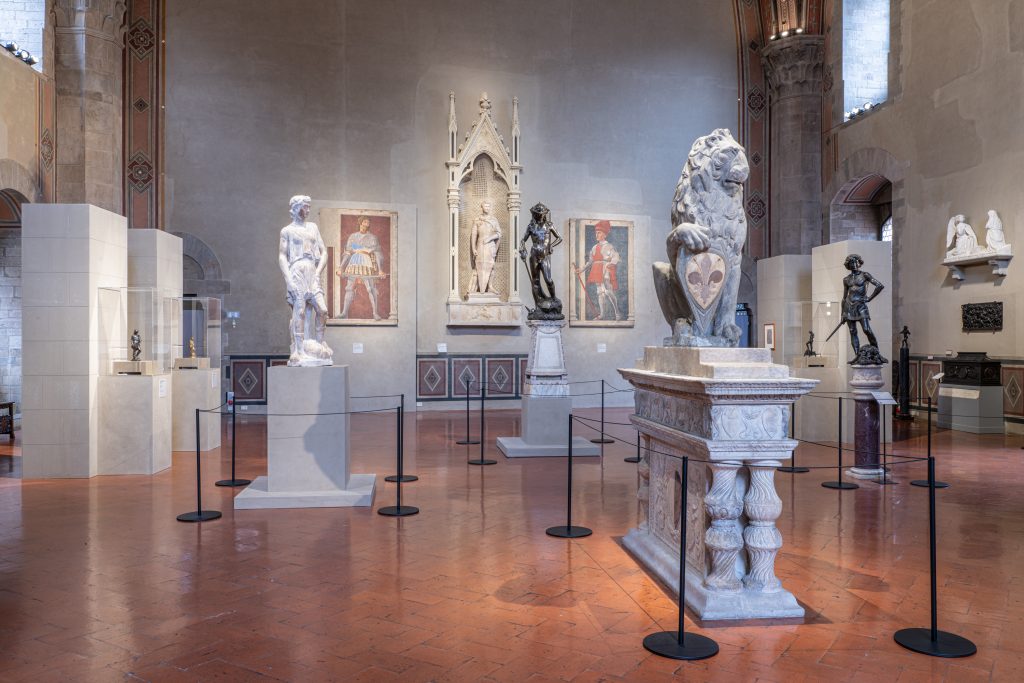
Moving through the exhibition, I found myself literally gasping at the curator'southward audacity in procuring seemingly impossible loans that create unparalleled comparisons. In the offset room alone, we have Donatello'southward early masterpiece, the marble David that very rarely moves from the Bargello, flanked by two crucifixes that are part of Vasarian lore; Giorgio Vasari says that Brunelleschi criticized a crucifix that Donatello sculpted for Santa Croce, saying it looked similar a peasant on a cantankerous, and then proceeded to make a more appropriately Christ-like version for Santa Maria Novella. These early works serve to highlight the of import collaboration betwixt two fundamental artists of the Renaissance, as well equally to bear witness Donatello's precocious talent for naturalism.
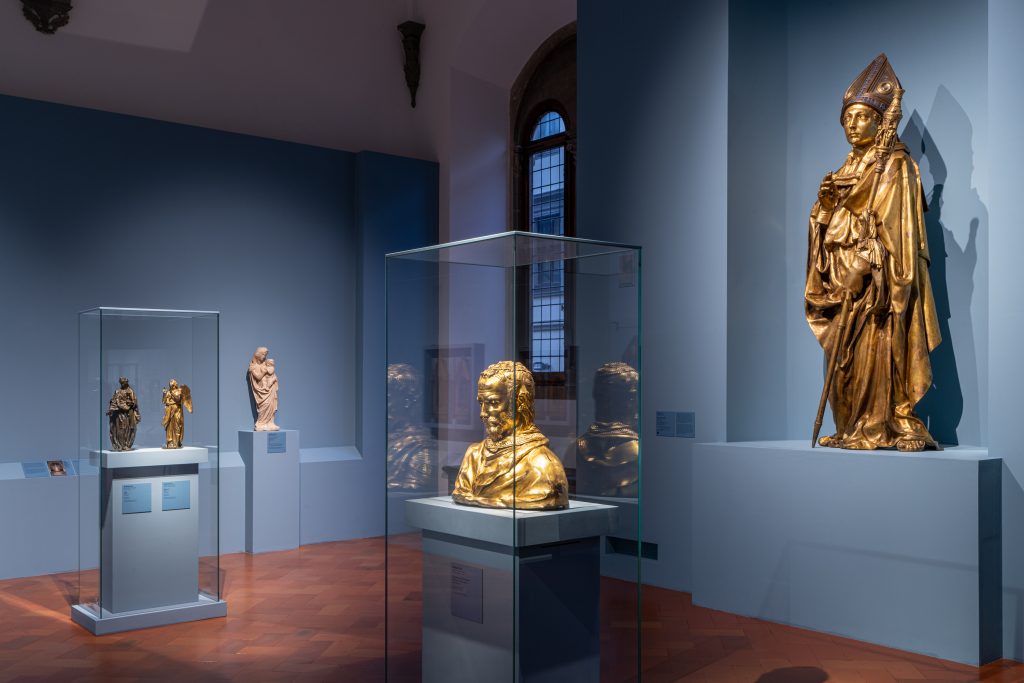
Beyond comparisons like this, the exhibition gives us access to numerous sculptures loaned from museums away also equally newly restored works for the occasion, or only works within a dissimilar brandish context. For example, Donatello's large bronze Saint Louis of Toulouse from Santa Croce is placed lower here than it is in the museum beyond town, and so we tin clearly see its clever construction. As an economic solution, information technology was cast in numerous pieces that requite the impression of depth and volume, while actually being an empty shell.
Restorations
The exhibition has been an opportunity to fund xiv restorations, viii of which are works by Donatello. It's a particular pleasure to get a shut expect at the Feast of Herod console from the baptismal font in the Baptistery of San Giovanni in Siena (1423-27), which demonstrates the artist'due south mastery of spatial illusion as a frame for human emotion. The committee in Siena for five reliefs recounting the story of the life of the Baptist pitted a mid-career Donatello against three of Tuscany'south top sculptors: Ghiberti, Jacopo della Quercia and Turino di Sano. Frequent visitors to the Bargello may recall here the competition panels for the first set of Florence Baptistery doors just 2 decades before (1401-02), in which Ghiberti emerged a clear winner confronting Brunelleschi due to his efficient apply of space to create action and emotion. In Siena, Ghiberti produces two works, ane staying true to his North Door style and the 2d anticipating his innovative Gates of Paradise that would represent the post-obit 25 years of his career and the next step in Renaissance sculpture. Donatello's relief is in a like manner, already attune to these changes, with a sensitive use of chiaroscuro that plays with aureate leaf and bronze, volume and void.
Smaller, more than private works of art
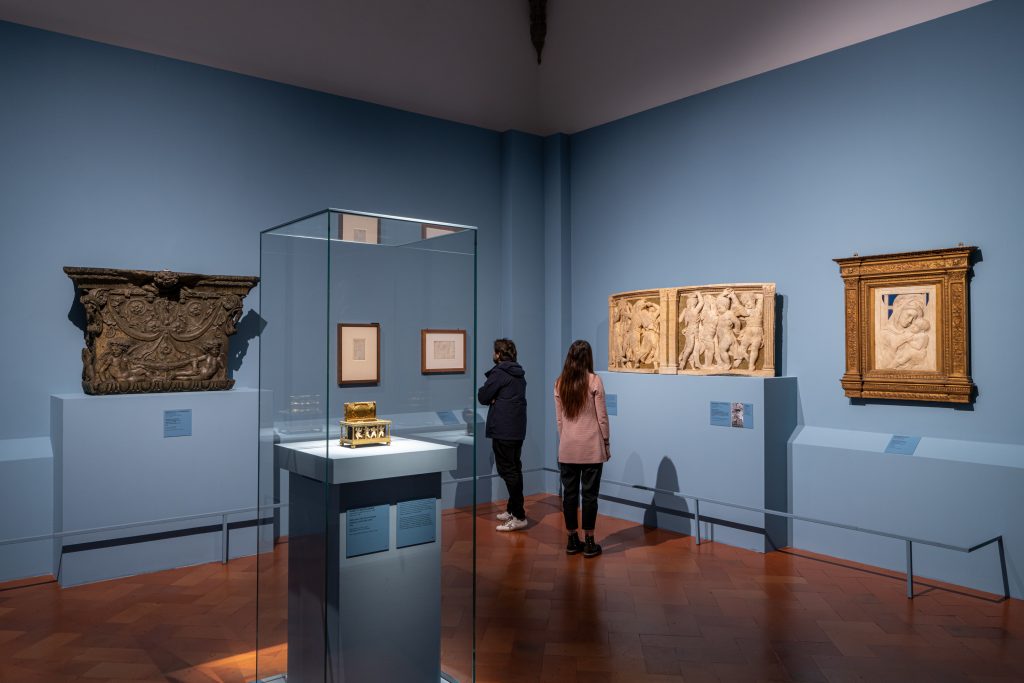
But this is non merely a show about monumental or important sculptural commissions, and that'south one of the reasons why I like it and then much. Important to understanding the whole of the creative person'southward impact on his era are the smaller, more private works that Donatello and his workshop dedicated much time to producing. These charming Madonna and Child figures were a household staple in middle-class Renaissance Florence. Gesso and terracotta versions might adorn walls of more modest households, while painted or marble sculpted versions would be the territory of the urban center's patricians. The tender, intimate Pazzi Madonna (1422), a low-relief marble, is a key loan from Berlin'south Staatliche Museen and is indeed present on the exhibition posters around the city. The curators use information technology equally an early example of the cosmos of three-dimensional infinite through one-betoken perspective. Much admired, this work was replicated in terracotta and stucco, where the melancholia limerick of the 2 figures carried on, while the innovative surface and perspective were lost.
The exhibition Donatello, The Renaissance clearly represents massive collaboration amidst museums and institutions. The show is set to travel, with variations on the loans and catalogue, to the Staatliche Museen in Berlin and the Victoria & Albert Museum in London. With the dominating presence of central works from the Bargello Museum, it'south hard to imagine that versions in other cities will be quite as extensive as the Florence 1, so I'm convinced that this is a show that could only happen—and should be seen—in Donatello'southward birthplace.
Donatello, The Renaissance
Palazzo Strozzi + Museo Nazionale del Bargello
March xix to July 31, 2022
www.palazzostrozzi.org
Source: https://www.theflorentine.net/2022/04/07/exhibition-review-donatello-the-renaissance-palazzo-strozzi/
0 Response to "Donatello How Old Was Donatello When He First Started Art"
Post a Comment