Art From the Medieval Period Art From the Past
The Medieval menstruum, commonly referred to as the Middle Ages, spans over one thousand years. The Roman Empire's fall effectually 300 CE marked the starting point of the Medieval flow, which lasted until the first of the Renaissance around the early 1400s. This period was an exceptionally influential era of Western art culture which gave rise to many famous Medieval paintings. Major art movements took place during this fourth dimension. New art genres were created, and different artistic traditions were meshed, including styles from the Middle E and Northern Africa.
Table of Contents
- 1 What Did the Medieval Art Movement Represent?
- 2 Our Top x Most Famous Medieval Paintings to Exist
- two.1 Christ Pantocrator (Sinai) (c. 500 – 600)
- 2.ii Lamentation (The Mourning of Christ) (1306) by Giotto di Bondone
- two.3 Maestà (c. 1308 – 1311) by Duccio di Buoninsegna
- 2.4 Ognissanti Madonna (c. 1310) by Giotto di Bondone
- 2.5 Declaration with St. Margaret and St. Ansanus (1333) by Simone Martini and Lippo Memmi
- 2.6 The Apologue of Good and Bad Regime (c. 1338 – 1339) by Ambrogio Lorenzetti
- ii.vii Crucifixion Altarpiece (c. 1394 – 1399) by Melchior Broederlam
- ii.8 Wilton Diptych (c. 1395 – 1399)
- 2.9 The Trinity (c. 1411 – 1427) by Andrei Rublev
- 2.10 Admiration of the Magi (1423) by Gentile da Fabriano
- three Oftentimes Asked Questions
- three.ane What Are the Different Types of Medieval Paintings?
- 3.two What Are Some of the Common Characteristics of Medieval Fine art?
- iii.3 What Was the Mode of the Medieval Art Period?
What Did the Medieval Art Move Represent?
Medieval art was established from the Roman Empire'due south artistic heritage and the Early Christian church'due south iconographic customs, along with the "barbarian" manner of Northern Europe. The mix of these sources led to the development of an incredible artistic legacy. The Medieval art menstruum encompassed different creative movements, involving mainly the Early on Christian art move, the Byzantine art motion, the Romanesque art movement, and the Gothic fine art move.
Although the mode of the art produced during this period varied, it was unified by various common factors. Most importantly, it reflected the sweeping popularity of Christianity.
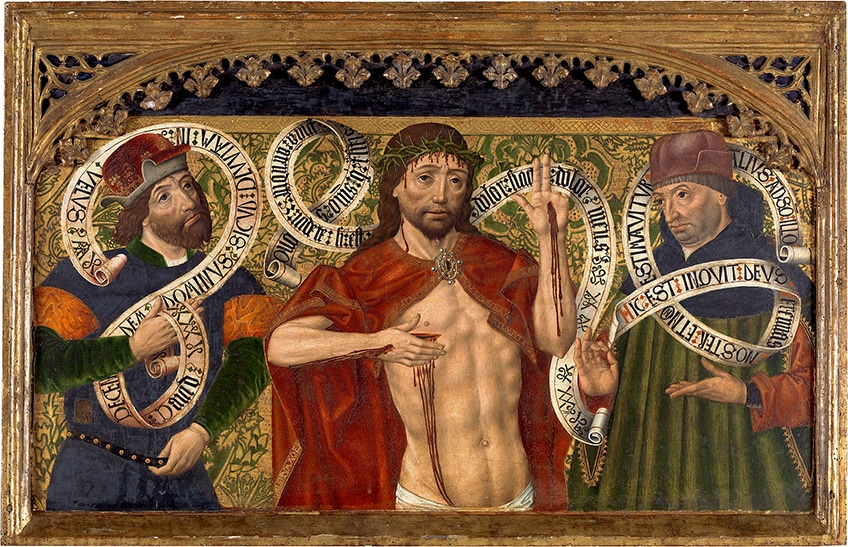 Christ of Mercy between the Prophets David and Jeremiah (betwixt c. 1495 and c. 1500) past Diego de la Cruz; Diego de la Cruz, Public domain, via Wikimedia Eatables
Middle Ages paintings were rich with religious symbolism and imagery. Medieval artists and their paintings predominantly portrayed holy figures and biblical narratives. These narratives had a hierarchy, which was predominantly dictated past the spaces the paintings would occupy. The Medieval artwork that depicted scenes considered to be more important would occupy notable focal points in a church building or altarpiece, whereas less meaning scenes would radiate outwards.
These Medieval fine art examples could exist roughly classified into fresco, panel, illuminated manuscript, and iconography painting.
Although Medieval artwork primarily served a religious function, there was an increase in secular subject thing that was being included in Middle Ages paintings. The visual arts went through a transitional period during the Medieval era, every bit the objectives of artists endured a radical alter.
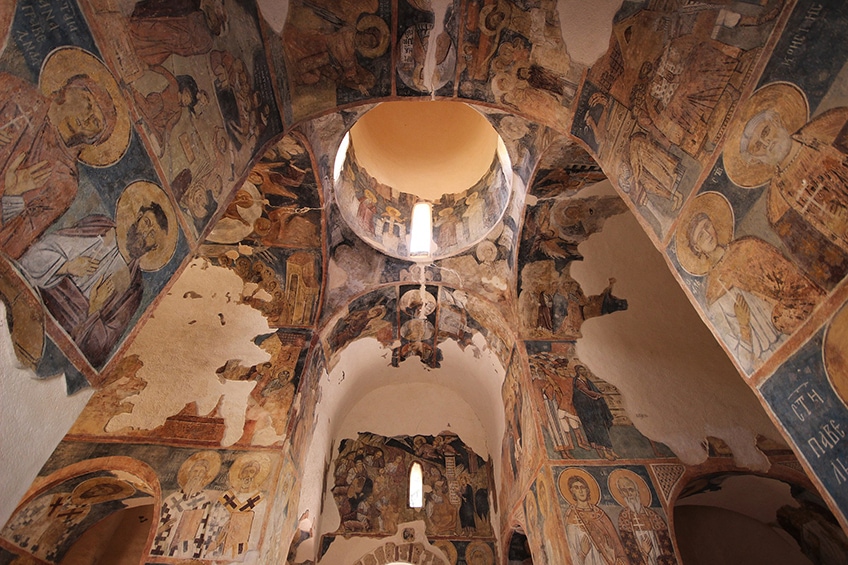 Medieval frescoes in the Zemen Monastery in Bulgaria;Bollweevil, CC0, via Wikimedia Commons
Medieval painters shifted from the rigid formulas necessitated by Romanesque painting, towards a representation of the world that was more than realistic and a want to achieve a three-dimensional consequence in their painting. This introduction of Medieval paintings that portrayed non-religious subject field affair and secular details immune artists to express a diversity of emotions and describe contemporary life more than realistically.
Additionally, decorative art was common in Medieval paintings.
Religious paintings often had gold in their backgrounds, on which heated tools were sometimes used to imprint intricate designs through a process called 'tooling'. Medieval painters accomplished elegant blueprint in their artwork by curving the draperies and depicting the sway and movement of the homo body. Bodies were no longer depicted as potent and flat; the illusion of movement and fluidity was becoming mutual exercise.
The Medieval art period remains a prevalent area of study for collectors and scholars, as a big volume of Medieval artwork produced during this menses has been recognized for its historical significance. Medieval artists and their paintings demonstrated the technical advancements and all-encompassing achievements of this period, which were cardinal to informing the progress of later Western fine art.
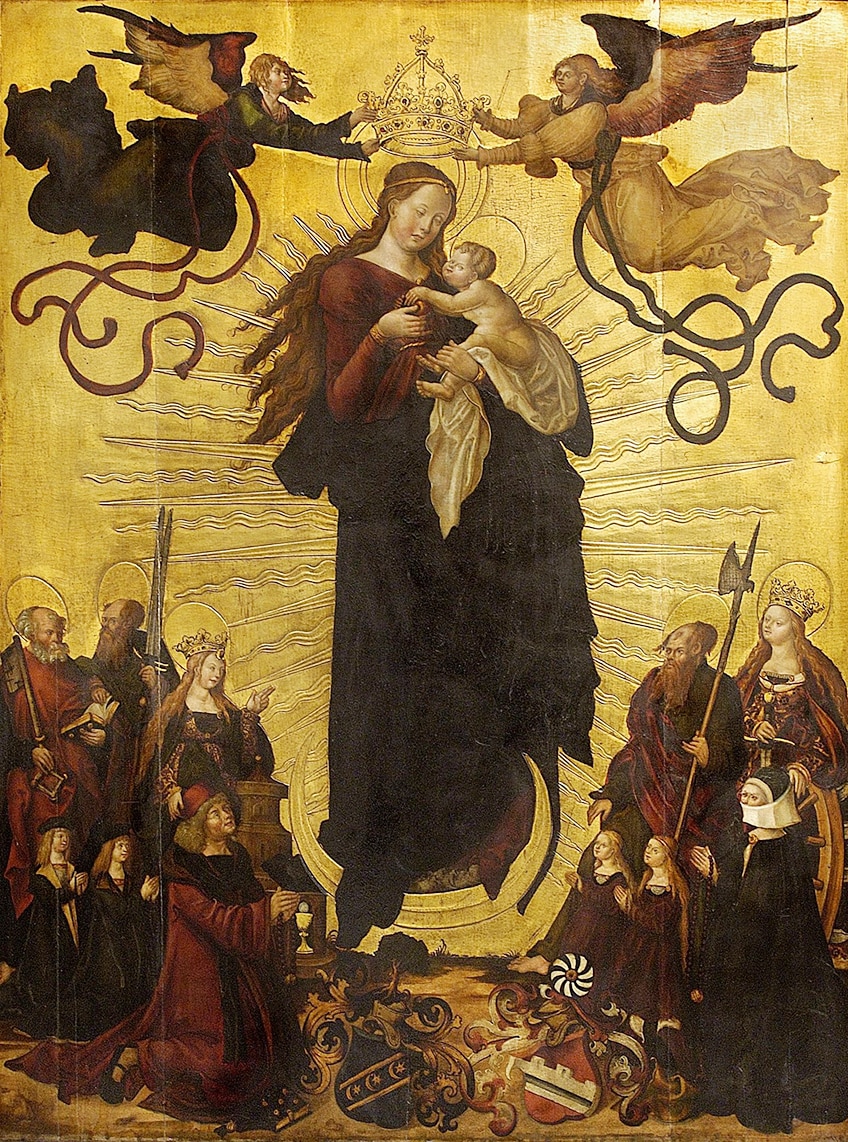 Epitaph of Nikolaus Lindner(c. 1511) by Anonymous;National Museum in Warsaw, Public domain, via Wikimedia Commons
Our Peak x Most Famous Medieval Paintings to Be
The Medieval art menstruation spanned over k years and encompassed a diverse range of artistic movements. Many notable Medieval art examples stand out as there was a vast variety of fine art produced during that time. However, specific Medieval artists and their paintings accept been recognized every bit instrumental for their masterful techniques and their contribution to the progression of art.
This is our choice of the 10 most famous Medieval paintings from the Medieval art movement.
Christ Pantocrator (Sinai) (c. 500 – 600)
| Artist | Unknown |
| Engagement Painted | c. 500 – 600 |
| Medium | Encaustic and gilded on wood |
| Dimensions | 84 cm x 45.5 cm |
| Where Information technology Is Currently Housed | Saint Catherine'due south Monastery, Sinai, Egypt |
Although a cracking deal is non known nigh the Christ Pantocrator (Sinai), this Medieval painting has been recognized as one of the oldest religious icons in the Byzantine style. The creative person remains unknown, only the Christ Pantocrator, translated to hateful "Christ the savior", dates back to the 6th century. The painting depicts Christ with a raised right manus, which signified his gift of blessing, and in his left arm, he held a Gospel book that was decorated with jewels in the shape of a cross.
The painting is purposely asymmetrical, as it symbolizes the duality of Christ. The gold halo framing Christ's caput makes this more than apparent. When looking at the depiction of Christ'southward face, on the side where Christ holds the Gospel (the right side of the painting), Christ's features are depicted as severe and hard.
This side was painted with more than depth and shadow, illustrating a more three-dimensional representation of Christ with a sense of realism. This realism was representative of Christ'south human nature.
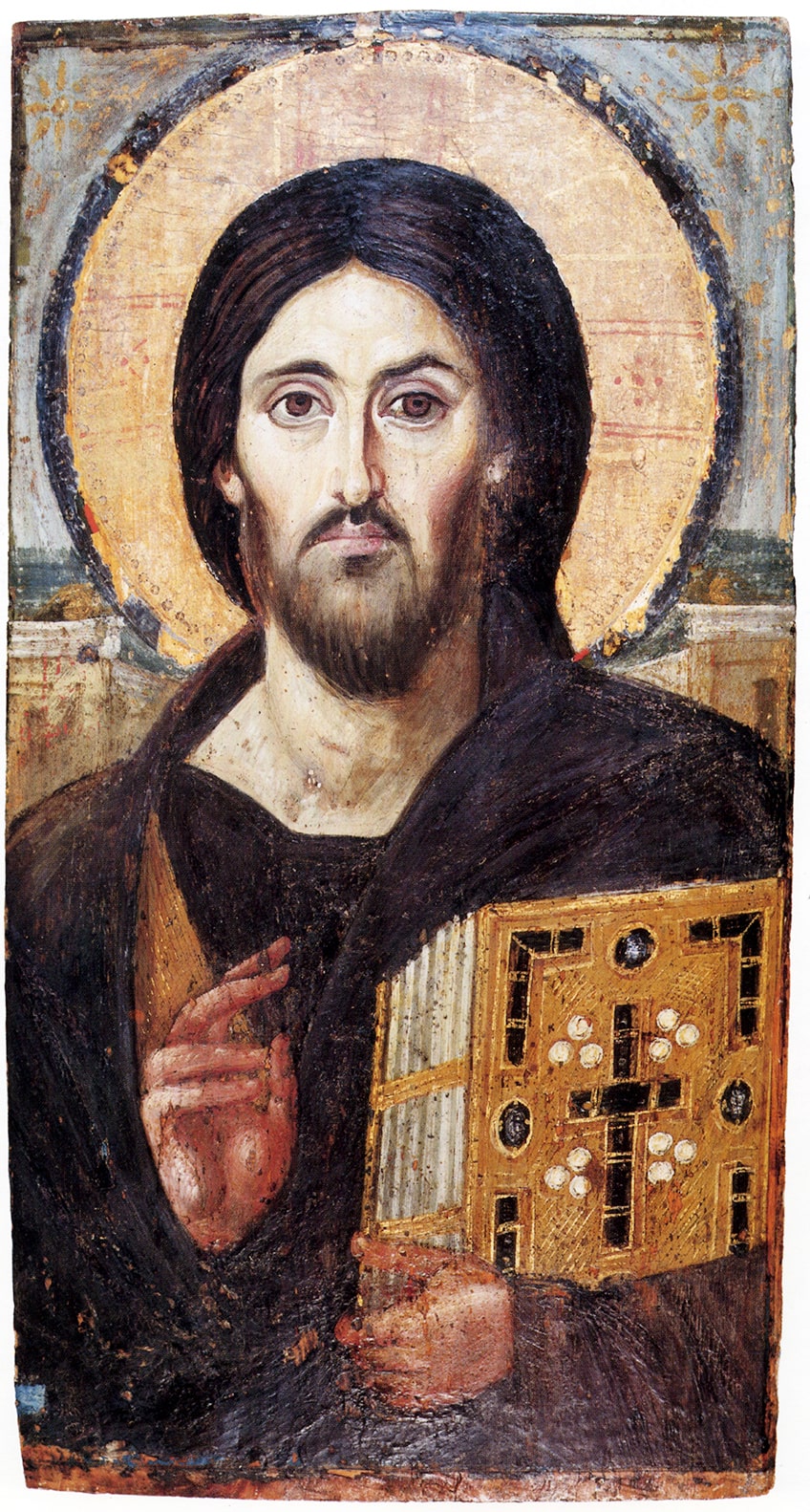 The oldest known icon of Christ Pantocrator, 6th-century encaustic icon from Saint Catherine's Monastery, Mount Sinai;Unknown artist Unknown artist, Public domain, via Wikimedia Commons
In dissimilarity, on the side where Christ's right mitt is raised (the left side of the painting), Christ's face is portrayed more serenely and calmly and this is representative of Christ'southward divinity. Additionally, information technology is portrayed with more light and softness, and it is flattened to illustrate a two-dimensional representation. This absence of realism serves to highlight the spiritualization of Christ and His role as savior.
This icon is an important piece of art, being the earliest known piece of artwork in the Pantocrator manner and i of the very few that survived the Byzantine Iconoclasm. The brilliance of the painting lies in the manner information technology seamlessly unifies the two halves of Christ's face up, depicting the Incarnate Christ as the union of both human and divine nature.
Lamentation (The Mourning of Christ) (1306) by Giotto di Bondone
| Creative person | Giotto di Bondone |
| Appointment Painted | 1306 |
| Medium | Fresco |
| Dimensions | 200 cm ten 185 cm |
| Where It Is Currently Housed | Scrovegni Chapel, Padua, Italia |
Giotto di Bondone has been considered as one of the most of import forerunners of the Renaissance. Giotto was an influential Italian creative person from the late Medieval period, oft referred to every bit the proto-renaissance. The Lamentation (The Mourning of Christ) has been recognized every bit one of his most notable works from the frescoes he painted for the Arena Chapel in Padua.
Giotto's Lamentation (The Mourning of Christ) forms part of the fresco serial used to draw the Life of Christ and the Life of the Virgin in the Scrovegni Chapel. The painting depicts the moment later Christ was crucified, where his lifeless torso was tended to by haloed relatives and disciples. Where Mary, the focal betoken, cradled Christ'southward caput as Mary Magdalene mourned at His anxiety.
Giotto was able to bring his figures to life and convey their feelings through the fine details of their hands and feet.
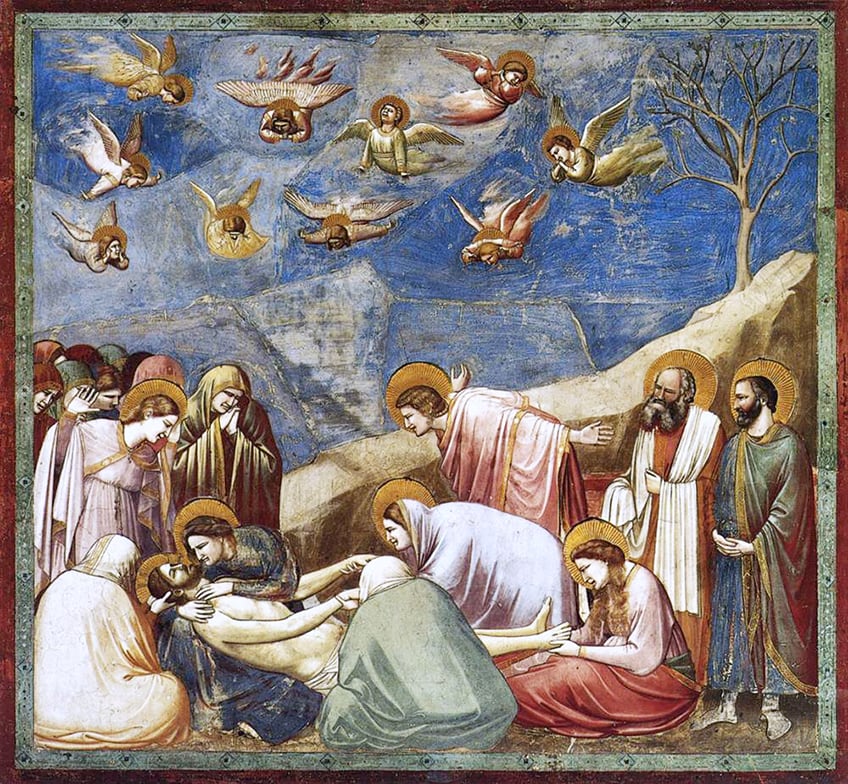 Scenes from the Life of Christ: twenty. Lamentation (The Mourning of Christ)by Giotto di Bondone, 1306;Giotto, Public domain, via Wikimedia Eatables
Additionally, the positions of their bowed heads and opened mouths portrayed a deep sense of mourning and grief. Their gestures connote sympathy and devastation for Christ's suffering. Not merely did Giotto'due south homo figures depict a sense of emotional realism, but the foreshortened portrayals of the grieving angels and the use of diagonal lines for the mountain ridge brought a sense of concrete realism to the composition.
Giotto decisively broke away from the Byzantine style and introduced the ground-breaking techniques of drawing accurately from life and co-ordinate to nature. Information technology strayed from the 2-dimensional conventions and provided depth and naturalized figures. He focused on the quality of realness in art as he observed humans and reproduced their gestures, expressions, and movement in his art.
Giotto's progressive artistry avant-garde naturalism, which later emerged equally an important feature in Renaissance sculpture and painting.
Maestà (c. 1308 – 1311) by Duccio di Buoninsegna
| Artist | Duccio di Buoninsegna |
| Engagement Painted | c. 1308 – 1311 |
| Medium | Tempera and aureate on woods |
| Dimensions | 370 cm x 450 cm |
| Where It Is Currently Housed | Museo dell'Opera Metropolitana del Duomo, Siena, Italy |
Duccio di Buoninsegna, the founder of the Sienese School of Painting, was one of the greatest Italian painters from the Medieval catamenia. The Maestà has been recognized as the greatest of all his works. The title Maestà meant The Virgin Mary in Majesty and this painting was function of a polyptych, therefore it formed part of an altarpiece made of many wooden panels.
The panels in the front draw the Madonna and Child enthroned and they are surrounded by saints and angels.
The Virgin Mary was garbed in an intense blue and the drape behind her was embroidered with gold, Duccio used exquisite colors in his panels. In that location were arable decorative surfaces in the painting which was very distinctive of the Sienese style. Duccio painted the Maestà with a sense of delicacy and subtlety, this can be seen by the habiliment that Christ was swaddled in and the transparency around his leg as a modulation of lite and shadow.
Duccio created a sense of mass and volume, as seen by the left hand of Christ pulling the drapery towards himself with the folds molded into the drapery. You begin to see the 3-dimensionality in the painting with the modeling of Christ's chin and neck. Correspondingly, the angel's wings are painted in a curled manner to farther indicate a sense of book rather than seeming flat.
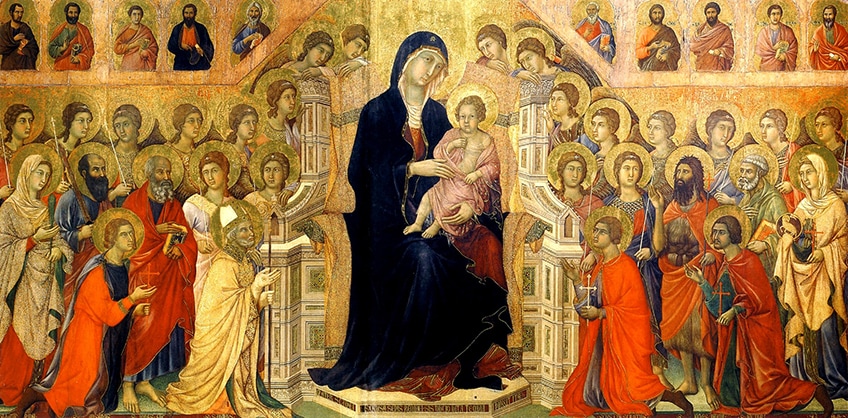 Primal console of the Maestà (1308–1311) by Duccio di Buoninsegna. Museo dell'Opera metropolitana del Duomo, Italy;Duccio di Buoninsegna, Public domain, via Wikimedia Commons
In the Maestà, the figures of saints and angels are almost life-size. It is important to note the relative size of the Virgin Mary, she is the largest figure in the painting. This is because Mary had the paramount role of interceding between God and mankind, as she was used past normal people to access God.
The Medieval artwork produced by Duccio combined the formalized Italo-Byzantine tradition with the Gothic manner's formulation of spirituality. This fusion brought a powerful spiritual gravity and lyrical expressiveness to his paintings.
Duccio steadily and consciously moved towards creating a sense of mass and volume in his painting which established a stylistic standard that influenced later artists.
Ognissanti Madonna (c. 1310) past Giotto di Bondone
| Artist | Giotto di Bondone |
| Date Painted | c. 1310 |
| Medium | Tempera on panel |
| Dimensions | 325 cm x 204 cm |
| Where Information technology Is Currently Housed | Uffizi Gallery, Florence, Italy |
Another painting by the influential artist Giotto di Bondone was his Ognissanti Madonna. The painting portrayed the Virgin Mary with the Christ Child, with figures of saints and angels surrounding them. Giotto's rendering of the Virgin Mary was volumetric and convincingly realistic as opposed to the flat, linear, conceptual, and unrealistic depictions that were more typical of the Byzantine manner in art.
Although this may be true, in that location were notwithstanding some elements that were in line with the traditional methods of the time such every bit the gold background and the hierarchical layout of the figures. Even so, Giotto was able to create a seemingly measurable depth in his paintings through perspective and lighting.
Giotto painted naturalized figures that looked more human being. In previous eras, the figures' beefcake underneath their clothes was not detailed, whereas Giotto took care to subtly correspond the impression of Madonna's chest and knees through her wearing apparel and Christ'south body through the robe he was draped in, which brought forth a sense of anatomical realism.
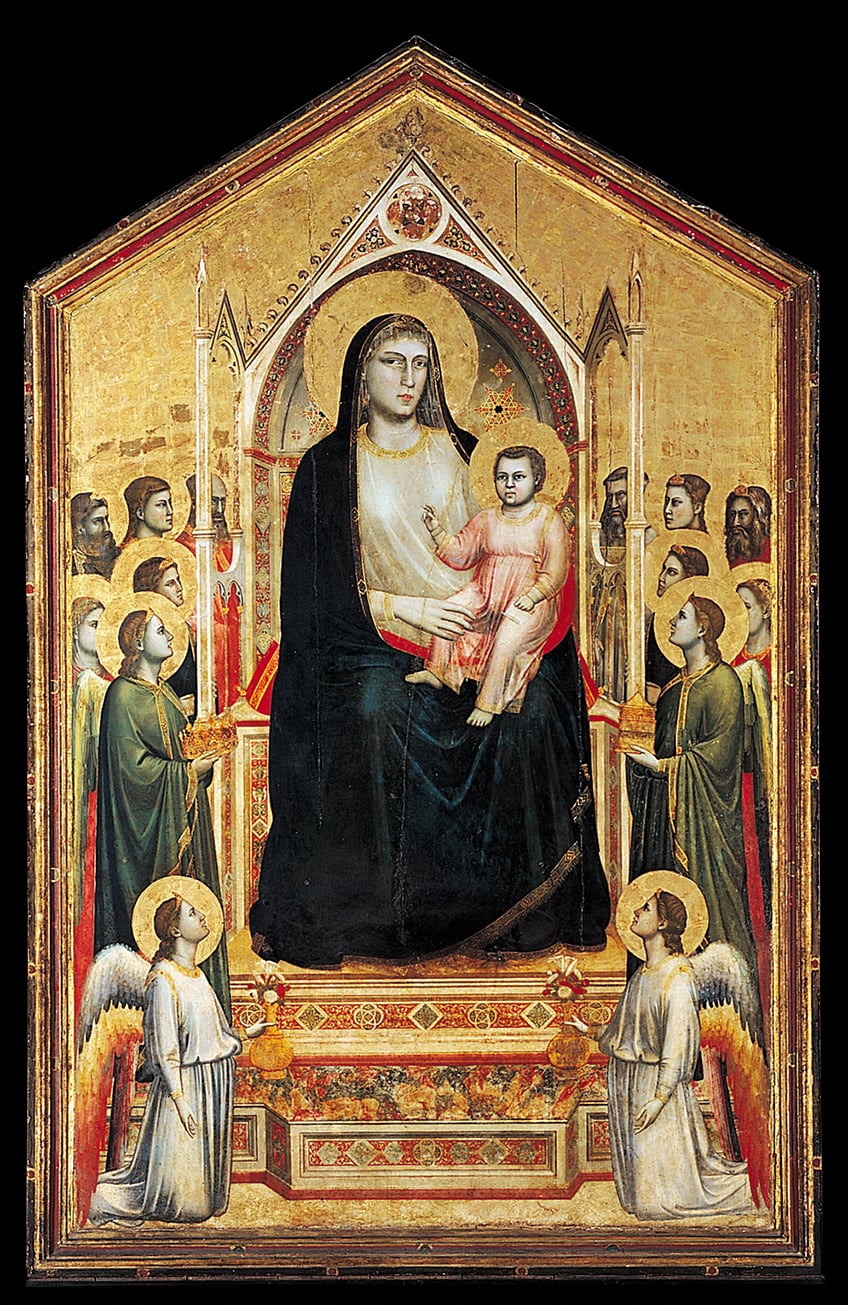 Madonna Enthroned (Ognissanti Madonna)(c. 1300-1305) past Giotto di Bondone;Giotto, Public domain, via Wikimedia Commons
Giotto used architectural perspective to depict the throne and pictorial space that corresponded with reality, where the figures around the Madonna were smaller and obeyed the spatial rules of the scene. The raised position of the Madonna and Child symbolized their spiritual height. Yet it was made more realistic because of the throne on which they were seated and the steps leading up to it. Christ's raised hand became the focal signal of the painting and the surrounding figures that gazed at him encourage yous to focus on him.
Although the Madonna was still enthroned as the Queen of Heaven, which was a typical Medieval delineation, Giotto'due south inclusion of steps leading to her throne made her more attainable. This gives the illusion that she was part of the spectator'southward world.
This was in line with the naturalism that would presently emerge as an important trait for Renaissance paintings going frontward.
Annunciation with St. Margaret and St. Ansanus (1333) by Simone Martini and Lippo Memmi
| Artist | Simone Martini and Lippo Memmi |
| Appointment Painted | 1333 |
| Medium | Tempera and aureate on panel |
| Dimensions | 305 cm x 265 cm |
| Where It Is Currently Housed | Uffizi Gallery, Florence, Italy |
Simone Martini and Lippo Memmi were Medieval painters from Italian republic who adopted the Gothic style in their artwork. Their painting Annunciation with St. Margaret and St. Ansanus was a wooden triptych that was painted in tempera and gold. It has been considered equally one of the virtually outstanding Gothic paintings and was recognized as Martini's masterpiece. The triptych was painted as a side altar for the Siena Cathedral.
The painting depicted the Annunciation in the central panel, where archangel Gabriel, who was carrying an olive branch, knelt before the seated Virgin Mary and informed her that she would soon comport the child of God. Gabriel was depicted holding an olive co-operative which is traditionally seen as a symbol of peace. The vase on the flooring between Gabriel and Mary was a symbol of purity. Above information technology, in the central arch, at that place were a group of angels whose wings interlocked, where the Holy Ghost's dove had descended from heaven.
Latin words that translate to "Hail, Mary, full of grace, the Lord is with thee" were embossed in gold and extended from the affections'south mouth towards Mary.
Martini had detailed the wings of the angels and the chair where Mary was seated exquisitely, which gave the painting a sense of elegant and precise refinement. On either side of the fundamental panel, the two patron saints of the cathedral were separated by two decorative twisting columns.
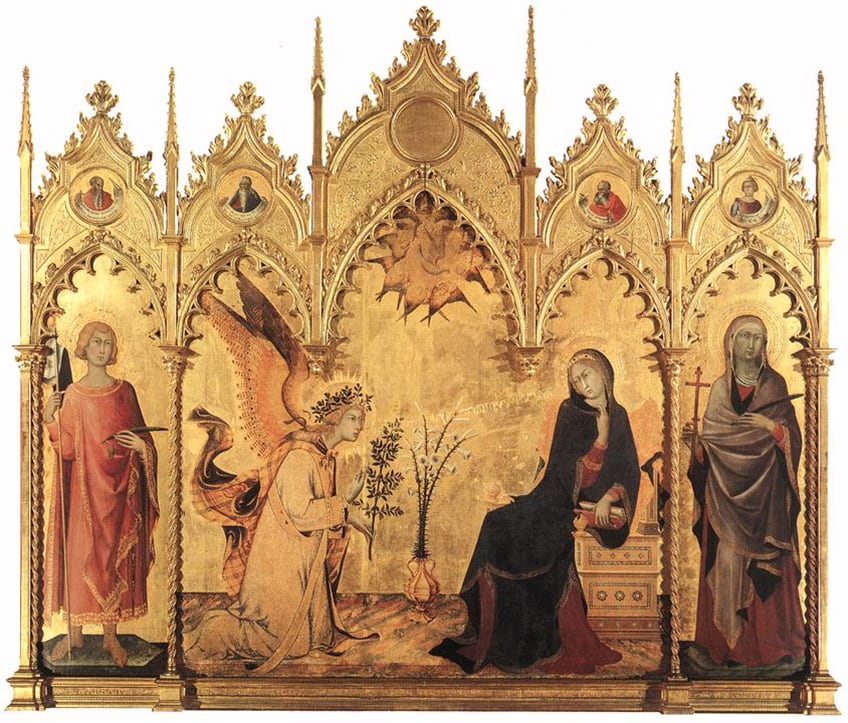 The Announcement and Two Saints (1333) by Simone Martini and Lippo Memmi;Simone Martini, Public domain, via Wikimedia Commons
Martini's central panel demonstrated his innovative utilization of line work combined with a sense of man expression and movement. The placement of the angel's gown made information technology seem to flare behind him as if he had recently landed, and Mary was depicted in a opinion that seemed quite reactive and emotive as if she was startled from her reading and in atheism of the celestial messenger.
Although the substantial use of gold and the subject matter of the painting reflected the traditional Byzantine style, the linework was representative of the Gothic way.
In addition, the employ of realistic elements such every bit the vase, the volume, the throne, the pavement that was in perspective, the realistic depiction of the ii figures, and the subtle nuances of their characters, all contributed to the significant disengagement from the typical Byzantine style. This portrayal of Annunciation with St. Margaret and St. Ansanus was unique for its fourth dimension.
The Allegory of Adept and Bad Government (c. 1338 – 1339) by Ambrogio Lorenzetti
| Artist | Ambrogio Lorenzetti |
| Date Painted | c. 1338 – 1339 |
| Medium | Fresco |
| Dimensions | 770 cm ten 1440 |
| Where It Is Currently Housed | Palazzo Pubblico, Siena, Italy |
Ambrogio Lorenzetti painted The Allegory of Practiced and Bad Authorities equally a serial of 3 frescoes in Siena'south Palazzo Pubblico in Italian republic. The frescoes consisted of six different scenes: Allegory of Practiced Government; Allegory of Bad Authorities; Effects of Bad Government in the Urban center; Effects of Good Government in the Metropolis; Furnishings of bad Government in the Country; and Effects of Good Government in the Land.
This painting is considered to be Lorenzetti's masterpiece.
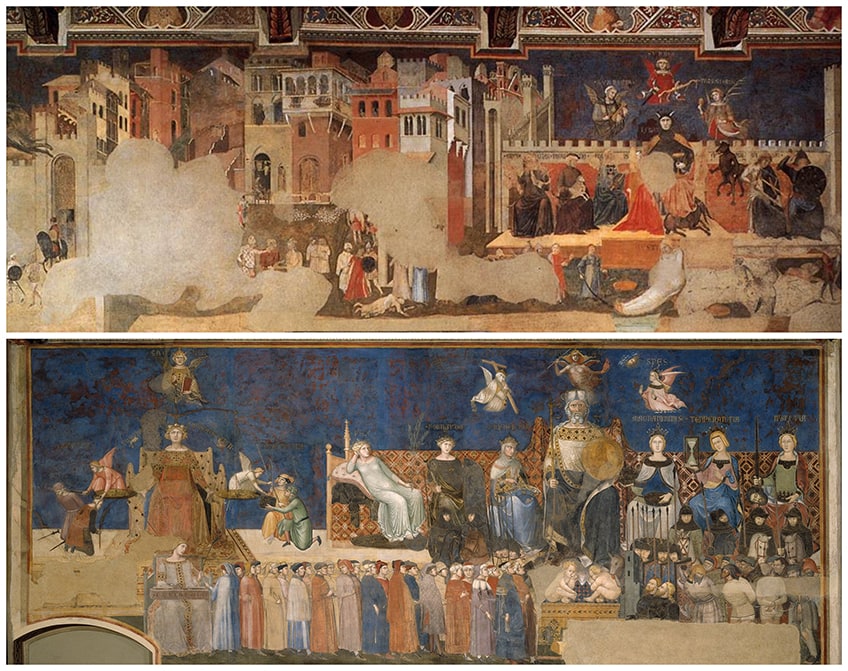 TOP: Allegory of Bad Authorities (c. 1338-1339) by Ambrogio Lorenzetti;Ambrogio Lorenzetti, Public domain, via Wikimedia Commons | BOTTOM: Allegory of Proficient Government (c. 1338-1339) past Ambrogio Lorenzetti;Ambrogio Lorenzetti, Public domain, via Wikimedia Commons
The Quango of Nine (the urban center council) commissioned the series in its entirety, this was recognized as a type of political message for the members of the Council to reduce misrule and corruption. The frescoes were secular depictions of symbolic figures of virtue, on how the republic was governed.
These paintings demonstrated an evolution in subject field affair from earlier fine art that was predominantly religious.
The frescoes demonstrated a pictorial stardom between the harmony and prosperity of ruling honestly versus the ruin and disuse resulting from tyranny. Lorenzetti's portrayal of the benefits of good government was depicted by a "good city" which featured dancers and traders and surrounding the city, travelers and peasants conducted their business in harmony.
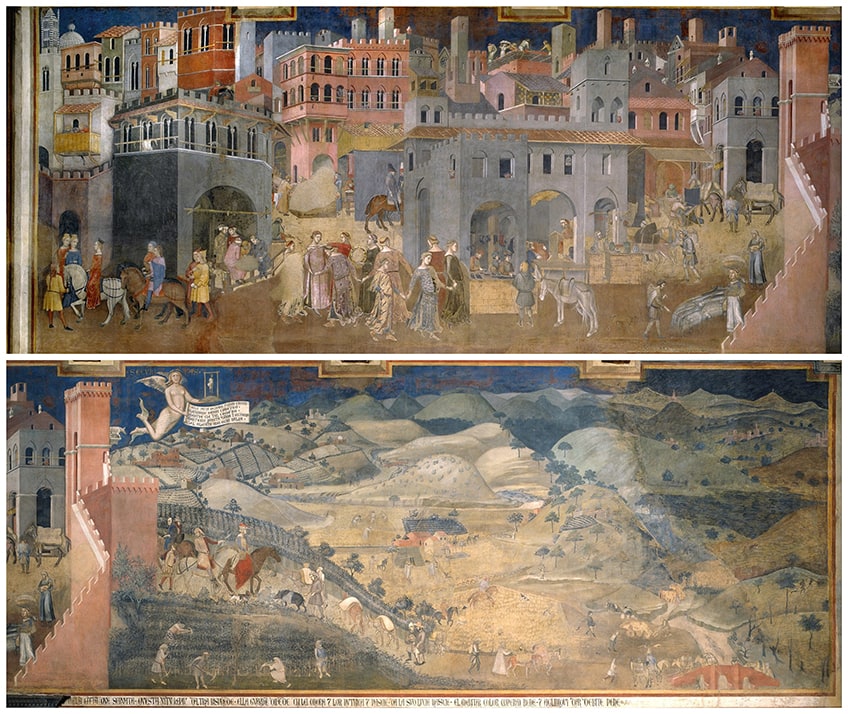 Height: Effects of Good Government in the city (c. 1338-1339) by Ambrogio Lorenzetti;Ambrogio Lorenzetti, Public domain, via Wikimedia Commons | BOTTOM: Furnishings of Proficient Government in the countryside (c. 1338-1339) by Ambrogio Lorenzetti;Ambrogio Lorenzetti, Public domain, via Wikimedia Commons
Whereas his portrayal of the effects of bad regime was depicted by a "bad city" which was decomposable, had a cramped appearance and street crime was distinctly visible. Surrounding the metropolis, the countryside was marked past farms that were called-for, disease, and extensive drought.
Lorenzetti'southward paintings demonstrated his artistic modernism, as tin be seen from his modeling of figures and their faces. Additionally, Lorenzetti'south paintings depicted realistic architectural angles and his use of archaic perspective immune the spectators to perceive the physicality of his paintings.
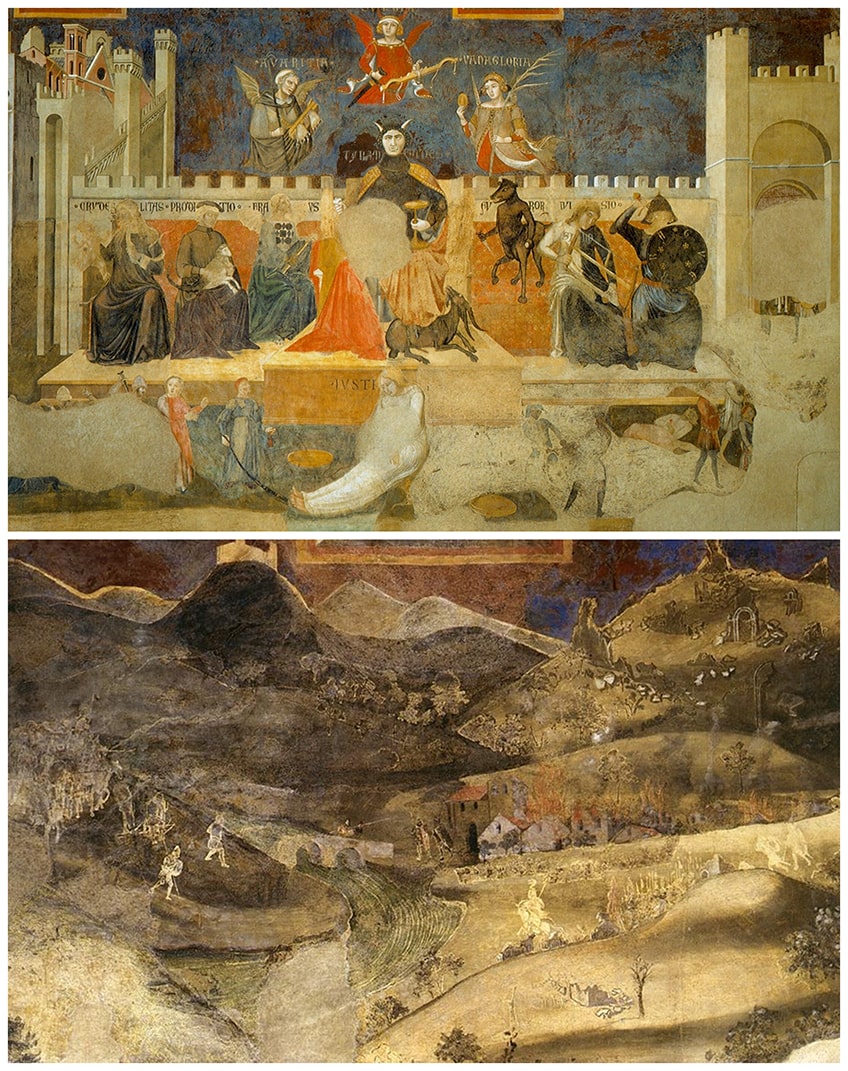 Acme: Effects of Bad Government in the city (c. 1338-1339) past Ambrogio Lorenzetti; Ambrogio Lorenzetti, Public domain, via Wikimedia Eatables | BOTTOM: Effects of Bad Government in the countryside (c. 1338-1339) by Ambrogio Lorenzetti;Public Domain, Link
Significantly, Lorenzetti's The Allegory of Good and Bad Government was one of the get-go notable artworks that depicted political secular fine art since the catamenia of classical antiquity. It has been said that Lorenzetti's frescoes foreshadowed the moralistic scenes that were later created by the painters Hieronymus Bosch in his Garden of Earthly Delights and Pieter Bruegel in his Netherlandish Proverbs.
Crucifixion Altarpiece (c. 1394 – 1399) by Melchior Broederlam
| Artist | Melchior Broederlam |
| Appointment Painted | c. 1394 – 1399 |
| Medium | Tempera on console |
| Dimensions | 167 cm x 249 cm |
| Where It Is Currently Housed | Musée des Beaux-Arts de Dijon, Dijon, French republic |
Melchior Broederlam was one of the primeval Flemish painters. His Crucifixion Altarpiece is comprised of two panels. Broederlam was commissioned past the Duke of Burgundy to decorate the exterior of the altarpiece with two painted panels for the Chartreuse de Champmol. Broederlam's Crucifixion Altarpiece has been recognized as a very famous painting to come out of the Medieval period.
The Crucifixion Altarpiece illustrated the Life of Christ: The Annunciation, the Visitation, the Presentation in the Temple, and the Flight into Egypt. Inside the altarpiece, the story continues with the Adoration of the Magi, the Crucifixion of Christ, and lastly Christ'southward Entombment.
Broederlam's panels accept been recognized equally magnificent examples of the Gothic manner, equally they featured rich colors such every bit gilt and naturalistic particular such as his use of low-cal and shadow to create depth. The architecture and figures were elegantly and delicately depicted.
The organization of the sacred buildings, which occupied ii of the four scenes, was quite distinctive. Broederlam painted both buildings as open to the outside world as if he was trying to testify both the interior and exterior at the aforementioned time.
This noticeable contradiction was a convention that was inspired by the Italian paintings from the 14th century.
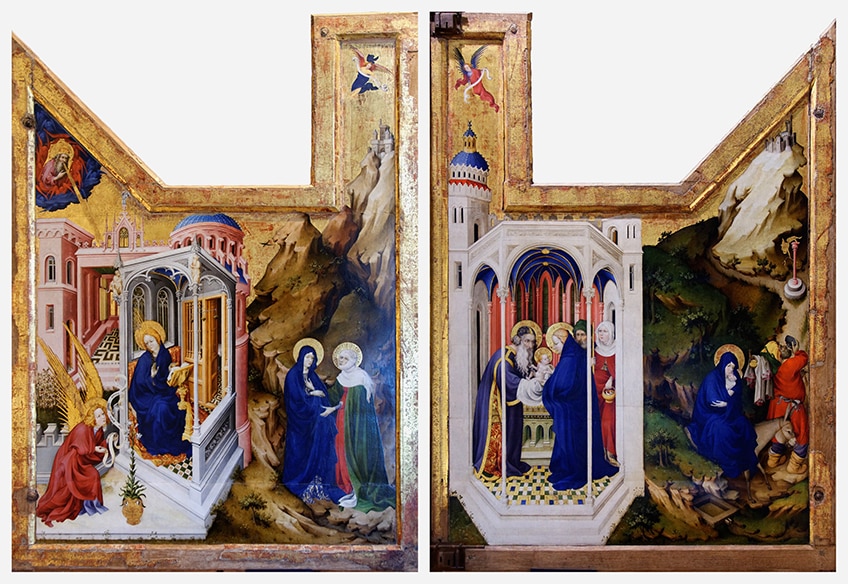 LEFT: Altar of Philip the Bold, Duke of Burgundy (Dijon Altarpiece) (1398) by Melchior Broederlam;Melchior Broederlam, CC By-SA 4.0, via Wikimedia Eatables | Correct: Presentation at the temple, Flight into Egypt (1398) past Melchior Broederlam;Melchior Broederlam, CC Past-SA 4.0, via Wikimedia Commons
In the Crucifixion Altarpiece, the pictorial elements were counterbalanced in each console and Broederlam arranged the figures, mural, and architecture in a way that created visual harmony. Moreover, the architectural structures in both panels were placed on the left, while the landscape was placed on the correct side of each console.
Correspondingly, the rocky landscapes reached the top of both panels and in the rectangular projection of each panel, the infinite was filled by an affections. These elements were tied together by Broederlam's use of blue, pink, and red repeatedly on either side, which encourages you to move your eyes from ane scene to the next. Thus, Broederlam expertly created a sense of continuity across the individual events.
The influence of Broederlam's Italian counterparts from the 14th century was evident in his landscape depictions.
It was seemingly out of proportion with the surrounding buildings and figures. This was similar to what could be found in the Sienese School of Painting. It was axiomatic that Flemish artists had been exposed to their Italian counterparts from the early 14thursday century. These encounters created an international style based on the art in Italian republic, which was before long equally constitute in Prague, Dijon, or Cologne.
Wilton Diptych (c. 1395 – 1399)
| Artist | Unknown |
| Date Painted | c. 1395 – 1399 |
| Medium | Tempera on console |
| Dimensions | 53 cm 10 37 cm |
| Where Information technology Is Currently Housed | National Gallery, London, England |
The artist who painted the Wilton Diptych has remained unknown, but the highly revered painting is considered a rare masterpiece. The panel painting, made of oak, was a portable altarpiece that was fabricated for the King of England, Richard 2. It was used as a devotional piece to assist in prayer.
The painting combined secular and religious imagery.
When opened, the panel depicted the Rex kneeling before the scene of heaven. King Richard 2 was being presented by England's patron saints Edmund and Edward the Confessor, and John the Baptist, to the Virgin Mary property the Christ Kid, who were surrounded by eleven winged angels. The number eleven was meaning because Richard Ii became the King of England when he was 11.
The King's hands were presented to either give or receive Saint George's standard with the red cross. Christ's hand was raised to bless the standard, forth with King Richard's II rule, as if the Rex was given the divine correct to dominion by the Virgin Mary and Christ Child.
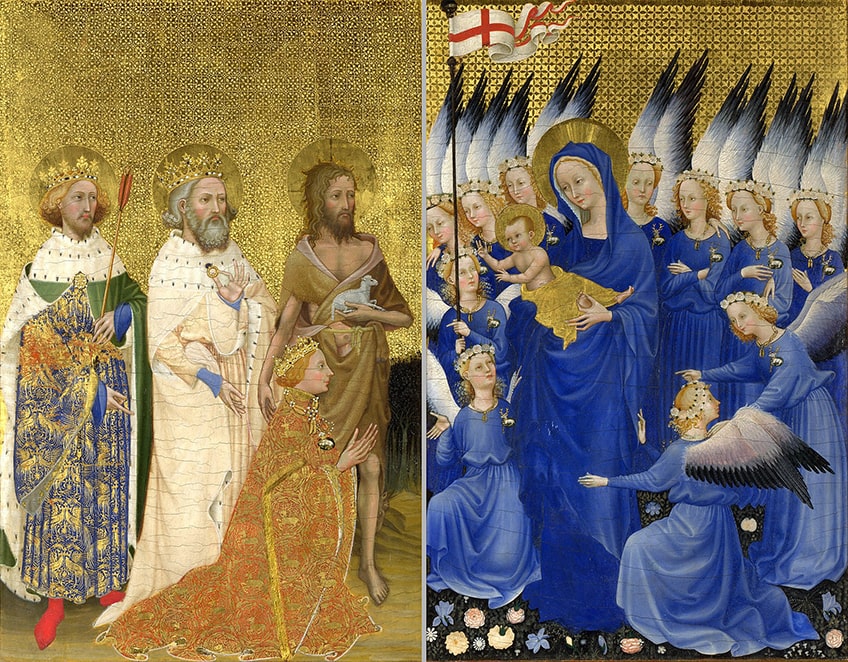 The Wilton Diptych (between c. 1395 and c. 1399) by an Unknown English language or French artist;National Gallery, Public domain, via Wikimedia Commons
The Wilton Diptych was painted in the International Gothic style. The refined detail of the painting is exceptional. The depiction of small-scale figures with their delicate facial features, and the robes they wore that roughshod in soft folds was intricately executed.
The painting is beautifully decorative and rich in colors of gilded and ultramarine blue.
The depiction is abundant with symbolism, such as Saint George's standard, the white hart badges that were worn by the King and the angels were representative of the Rex's bluecoat, and the rosemary in the flowers was allegorical of the King'south first wife Anne of Bohemia.
The Wilton Diptych is and so significant non only because of the richness of the paintwork, or the meticulously tooled gilding, or the extraordinary detail; but it is a very rare English language panel painting. The modest altarpiece is only i of a few English language panel paintings that survived from the Medieval menses.
The Trinity (c. 1411 – 1427) by Andrei Rublev
| Artist | Andrei Rublev |
| Date Painted | c. 1411 – 1427 |
| Medium | Tempera on wood |
| Dimensions | 142 cm x 114 cm |
| Where It Is Currently Housed | Tretyakov Gallery, Moscow, Russia |
Andrei Rublev was a Russian painter and his virtually famous work, The Trinity, was said to have been painted somewhere betwixt 1411 and 1427. Various scholars suggest different dates, just officially it has been postulated that it was either painted in 1411 or from 1425–1427. The icon was commissioned for the Trinity Monastery of St. Sergius to honour Saint Sergius of Radonezh. The painting depicted three angels seated at a table, with a chalice placed in the center.
Rublev's painting portrayed the angels who appear to Abraham and his married woman Sarah that they would have a son. More specifically, the three angels represented the Trinity, as the unity of God the Father, the Son, and the Holy Spirit. Although God is non represented in The Trinity, the painting is nevertheless able to demonstrate an ideal expression of God.
The three figures purposely share identical features, equally the Trinity is unified. This is where the belief is that God is 1, merely in three persons.
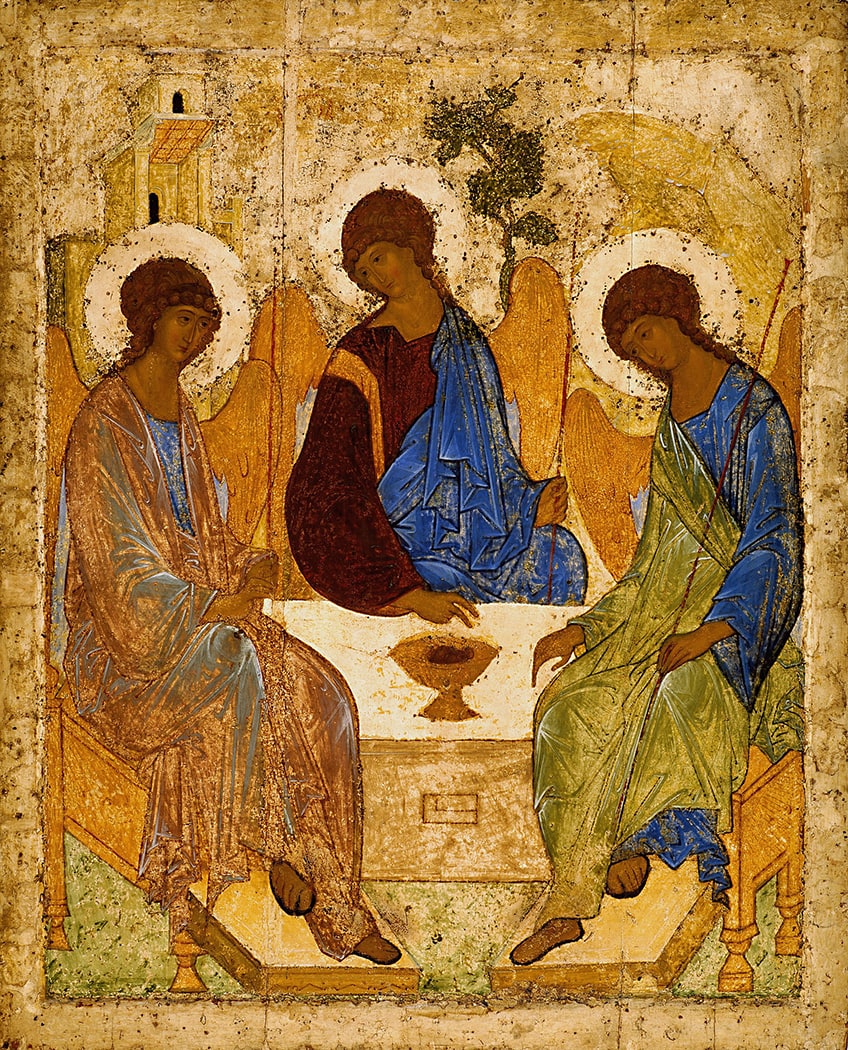 Holy Trinity (Troitsa)(1425-1427) by Andrei Rublev; Andrei Rublev, Public domain, via Wikimedia Commons
The painting is rich with symbolism. The unity of the Trinity was farther indicated past the blue garments worn by each angel. The painting conveys that the iii were engaged in a sacred give-and-take through gesture and gaze, and they surrounded the beaker which was symbolic of Christ's cede. Rublev'southward organization of the angels, the fluid lines used, and his delineation of the angels' article of clothing all contributed to the cosmos of a visual circle, which was symbolic of their unity. The circular composition imparts a sense of still contemplation.
As for Russian icons, "The Trinity" is recognized as the nigh famous interpretation. Rublev's icon was declared as the model for all Russian Orthodox icons. The painting is considered one of the greatest achievements of Russian art from the late Medieval period.
Adoration of the Magi (1423) by Gentile da Fabriano
| Creative person | Gentile da Fabriano |
| Date Painted | 1423 |
| Medium | Tempera on wood |
| Dimensions | 300 cm x 282 cm |
| Where It Is Currently Housed | Uffizi Gallery, Florence, Italy |
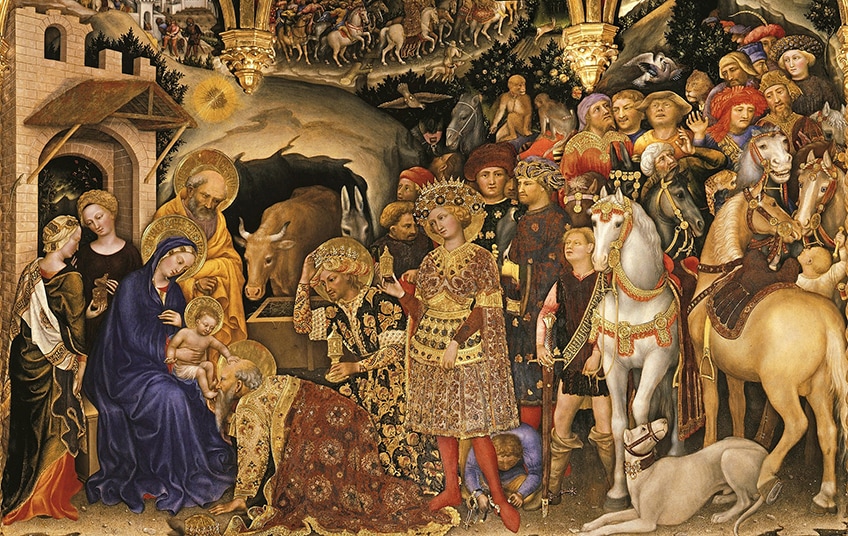
Gentile da Fabriano's painting, Adoration of the Magi, has been recognized as his finest painting. The altarpiece was commissioned by Palla Strozzi for the Santa Trinita church's family chapel. Adoration of the Magi depicted the travels of the Magi in various scenes. The scenes start in the upper left corner, which depicted the journey and archway into Bethlehem.
The scenes continue in a clockwise germination, the everyman part of the painting portrayed the meeting between the Magi and Virgin Mary and the newborn Christ Child.
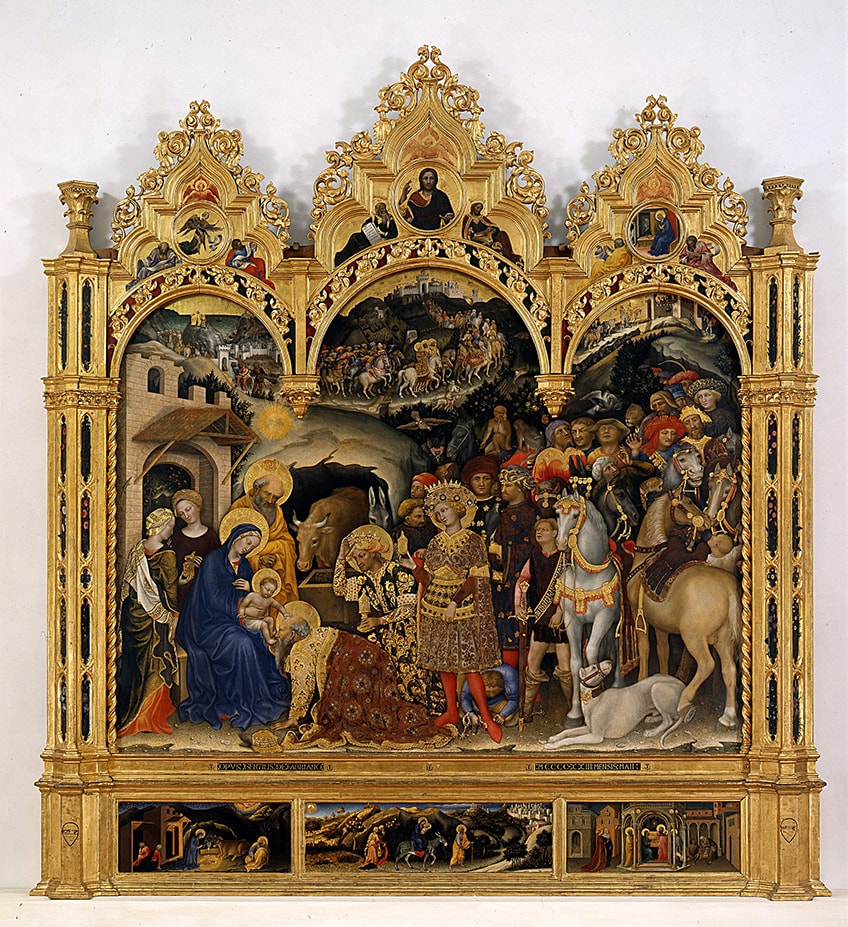 Adoration of the Magi Altarpiece(1423) by Gentile da Fabriano;Gentile da Fabriano, Public domain, via Wikimedia Commons
The vibrant colors in the painting are mesmerizing, which was due to the various ways in which gold foliage was applied and the use of precious pigments. The use of bright colors, intricate decorations, and opulent costumes were ascendant in the International Gothic style. Fabriano'south work culminated in the International Gothic style of the belatedly 14th century and early on 15th century. Fabriano's attending to detail was evident in his depiction of exotic animals, such as the leopard, the apes, the panthera leo, and the spectacular horses.
While the architectural frame for the painting was constructed for a triptych, Fabriano abased the convention of dividing the painting'southward composition. Instead, Fabriano spread the narrative across the panels.
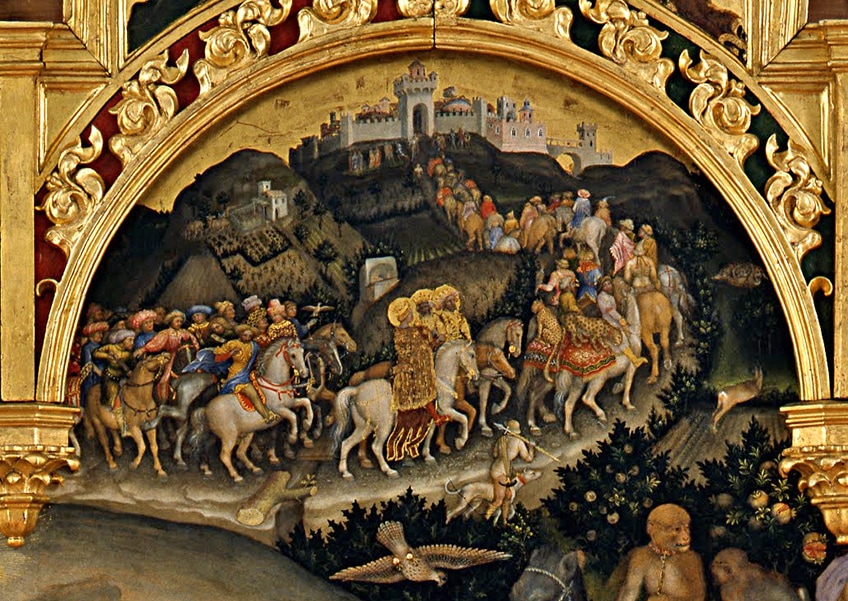 A detail from Gentile da Fabriano'south Adoration of the Magi Altarpiece (1423);Gentile da Fabriano, Public domain, via Wikimedia Commons
The composition of the painting combined the splendor of Gothic details with naturalism. For example, the placement of some of the animals contributed to the illusion of depth, such as the varying angles of some of the horses in the foreground and the foreshortening of others. These features of physical realism alluded to the linear perspective and naturalism that afterward dominated the Renaissance.
The frame itself has been recognized as a work of art, which is demonstrated by the three cusps at the top of the panels with tondos. These are circular works of art that portrayed Christ Approval in the eye and the Annunciation, with the Archangel Gabriel on the left side and the Madonna on the right side.
 A particular from Gentile da Fabriano's Adoration of the Magi Altarpiece (1423);Gentile da Fabriano, Public domain, via Wikimedia Commons
Beneath the panels, the predella has three paintings depicting scenes from Christ's childhood. This included the Birth, Flying into Egypt, and the Presentation at the Temple. Fabriano's Adoration of the Magi was the first altarpiece that was made with panel and frame equally two separate pieces, a fully independent and self-supporting frame, it was the first of its kind.
The paintings from the Medieval menses proceed to hold their weight to this day and remain influential works of fine art. Many paintings from this period went on to inspire bang-up works of art in the years to come up. While we have only explored x famous Medieval paintings, it is of import to acknowledge that Medieval fine art is of bully diverseness and at that place are many swell works outside of our listing. If you enjoyed learning about these exquisite paintings, we encourage you to continue exploring, as there are many art topics covered on our website.
We've also created a Google Spider web Story with our Top 5 famous medieval paintings.
Frequently Asked Questions
What Are the Different Types of Medieval Paintings?
The different types of Eye ages paintings can be roughly classified into fresco, panel, and iconography painting. Medieval art examples included a large number of fresco paintings, which involved the method of mural painting, and this was completed on wet lime plaster. The majority of fresco paintings were created for the interiors of churches. Panel paintings were executed on flat, often wooden panels. They were predominantly featured in religious spaces, namely church altarpieces, depicting religious subjects. These devotional panel paintings were either diptychs fabricated of two panels, triptychs made of three panels, or polyptychs made of multiple panels. Lastly, iconography painting was a significant type of Medieval painting and it incorporated the depiction of holy figures, biblical narratives, and religious concepts.
What Are Some of the Common Characteristics of Medieval Art?
Middle ages paintings varied quite a bit in manner, just they were unified by a few common factors. These common characteristics included the importance of portraying Christian subject thing, forth with the use of iconography to draw religious symbolism and imagery in Medieval artwork. Medieval painters included elaborate decorations and intricate patterns in their paintings, where a process called 'tooling' was used to imprint designs on the backgrounds of paintings which were often gold. When it comes to famous Medieval paintings, we oft detect that artists used bright colors such as the intense ultramarine blue, which was fabricated from grinding lapis lazuli, a semi-precious rock, into a powder. Eye ages paintings often incorporated precious gems and metals.
What Was the Mode of the Medieval Fine art Period?
The Medieval art period encompassed various artistic movements and styles. The major art movements included the Early on Christian art movement, the Byzantine art movement, the Romanesque art move, and the Gothic art movement. The Medieval art examples produced during the 13thursday and 15th centuries were predominantly in the Gothic style. This was regarded as visual art's transitional period. Medieval artists and their paintings shifted abroad from the rigid formulas necessitated past Romanesque painting, which in itself had been largely influenced by the Byzantine manner, towards a representation of the world that was more than realistic and a desire to achieve a three-dimensional effect.
Source: https://artincontext.org/famous-medieval-paintings/
0 Response to "Art From the Medieval Period Art From the Past"
Post a Comment